Module 1: Logic and the language of mathematics
EDUC 315 - Howard University
Module overview
This module provides an overview of fundamental concepts in number, logic, and mathematical reasoning. We’ll explore the principles of deductive and inductive reasoning, and begin to develop a foundation for understanding logical arguments and mathematical proofs.
We’ll also explore concepts such as quantity, structure, space, and change, which form the basis of the various mathematical disciplines. Special attention is given to the concepts of zero and infinity, their historical development, and their significance in mathematical thinking.
Notes
The concept of sets
A set is a well-defined collection of distinct objects. A set is considered as an object in its own right. Sets are foundational in mathematics because they provide a way to group and classify numbers, objects, or ideas. The items inside a set are called the set’s elements.
An element is an object or item in a set.
For example, for \(A = \{1, 3, 5\} \text{ and } B = \{2, 4, 6\}\), we say \(3 \in A\) and \(4 \in B\).
If an element \(a\) is in set \(A\), we write \(a \in A\).
If a is not in \(A\), we write \(a \notin A\).
The fundamental property of sets is that elements are either members or non-members – there is no in-between. The symbol \(\in\) (epsilon) is used to denote membership.
In this context, \(\in\) (epsilon) means: “is an element of,” “is a member of,” or simply “is in.” To indicate non-membership, we use \(\notin\). For example, for the same set \(A = \{1, 3, 5\}\), we write \(6 \notin A\).
A set \(A\) is a subset of \(B\) if every element of \(A\) is also in \(B\).
We write \(A \subseteq B\) to indicate subsets.
Union
The union of sets \(A\) and \(B\) is the set of all elements in \(A\) or \(B\):
\[ A \cup B = \{ x \mid x \in A \text{ or } x \in B \} \]
Intersection
The intersection of sets \(A\) and \(B\) is the set of all elements in both \(A\) and \(B\):
\[ A \cap B = \{ x \mid x \in A \text{ and } x \in B \} \]
Complement
The complement of set \(A\) (relative to a universal set \(U\)) is the set of all elements in \(U\) not in \(A\):
\[
A^{c} = \{ x \in U \mid x \notin A \}
\]
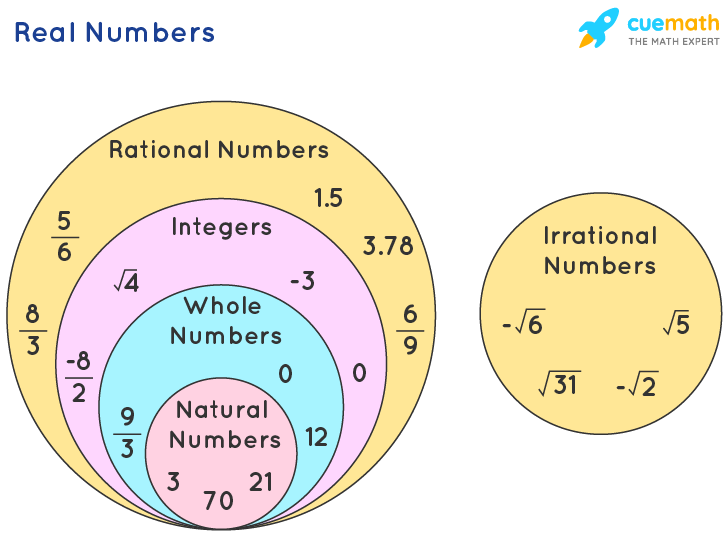
Sets of numbers
Natural numbers
The set of natural numbers, \(\mathbb{N} = \{1, 2, 3, ...\}\)
Whole numbers
The set of whole numbers, \(\mathbb{N_0} = \{0, 1, 2, 3, ...\}\)
Integer numbers
The set of integers, \(\mathbb{Z} = \{..., -3, -2, -1, 0, 1, 2, 3, ...\}\)
Rational numbers
The set of rational numbers, \(\mathbb{Q} = \{\dfrac{a}{b}, a \in \mathbb{Z}, b \in \mathbb{Z}, b \ne 0\}\)
Real numbers
- The set of real numbers, \(\mathbb{R} = (-\infty, \infty)\)
Other sets
What sets are missing? How can you define and visualize these other sets?
Framing mathematics and science
Science is the systematic study and pursuit of knowledge about the natural and physical world through observation, experimentation, and the formulation of testable hypotheses. It involves a methods-based approach to understanding phenomena and developing explanations based on empirical evidence. Mathematics is the science that deals with the logic of quantity, structure, space, and change.
Logic
Logic refers to the principles of reasoning, especially correct reasoning. It’s the systematic method of coming to conclusions through rational thought. In mathematics, logic involves the formal principles of reasoning and inference used to derive valid conclusions.
Reasoning
Deductive reasoning: Deductive reasoning is a logical process that involves drawing specific conclusions from general premises or principles that are assumed to be true. This form of reasoning is often described as a “top-down” approach, where one starts with a general statement and applies it to a specific case. In mathematics, deductive reasoning involves using established rules, facts, and theorems to draw specific conclusions. It moves from general principles to specific instances.
- For example, if we know that “All fish live in water” and “Nemo is a fish,” what can we conclude?
Inductive reasoning: Inductive reasoning is a logical process that involves drawing general conclusions from specific observations or instances. This method is often referred to as “bottom-up” reasoning, contrasting with deductive reasoning, which moves from general principles to specific conclusions. In mathematics, inductive reasoning involves observing patterns or specific instances to form general conclusions or hypotheses.
Using if-then statements.
Quantity
Quantity relates to the amount or number of something that can be measured or counted. In mathematics, it deals with concepts like magnitude, size, or amount that can be expressed numerically.
Structure
Structure in mathematics refers to the way mathematical objects are organized or arranged. It involves the relationships and patterns between mathematical entities, such as the properties of number systems or the organization of geometric shapes.
Space
In mathematics, space refers to the framework within which points, lines, shapes, and other geometric objects exist. It can be two-dimensional (like a plane), three-dimensional (like our physical world), or even higher-dimensional in abstract mathematics.
Change
Change in mathematics deals with how quantities or properties vary or transform over time or under different conditions. This concept is fundamental to areas like calculus, which studies rates of change and accumulation.
What do we mean by zero?
Zero is a number that represents the absence of quantity or magnitude. It is the integer between the set of all negative integers and all positive integers.
Examples
The empty set: \(\emptyset\) or \(\{ \}\).
The number line: A starting point on number line.
Counting: of you have a basket of apples and remove all of the apples, you are left with zero apples.
Temperature: On the Celsius scale, zero degrees represents the freezing point of water.
Key Points:
Zero as a placeholder in our number system.
The role of zero in mathematics (e.g., additive identity).
Historical developments of the concept of zero:
Dividing a number by zero, \(\dfrac{x}{0} = \text{undefined}\) for some number \(x \neq 0\)
Dividing zero by zero, \(\dfrac{x}{0} = \text{undefined}\) for some number \(x = 0\).
What do we mean by infinity?
Infinity is a concept describing something without any limit, and is larger than any real number. It is often denoted by the symbol \(\infty\).
Examples
The number line: You can always add 1 to any number, no matter how large, so the number line extends infinitely.
Fractional division: 1 divided by 3 results in a repeating decimal (0.333…) that goes on infinitely.
Key Points
Different types of infinity (countable and uncountable)
The concept of infinity in mathematics vs. everyday life
Paradoxes involving infinity (e.g., Hilbert’s Hotel)